

Pressure Washing Skid: The Pro Contractor's Buying Guide
A pressure washing skid is a self-contained, vehicle- or trailer-mounted cleaning platform that integrates your pump, engine, tanks, hose reels, and chemical systems on a single base frame — and for most contractors scaling commercial work, buying a turnkey custom skid from FlowCraft Wash Systems is the fastest path to production-ready capacity. Three configurations worth starting with: the Blank Equipment Skid (for operators who want a proven base to build on), a soft-wash skid setup, and a full turn key wash skid setup.
Why this approach beats piecing it together yourself:
-
Production capacity: A fully integrated skid cuts per-job setup and breakdown time, and those minutes add up to real hours across a week of commercial accounts.
-
Serviceability and warranty: FlowCraft Wash builds with engineered drawings, USA materials, AWS certified welders and backs its systems, so you know what’s in the rig and who to call.
-
Integrated soft-wash capability: FlowCraft configurations support both pressure washing and soft-wash chemical delivery from a single platform, which is the combination most residential and commercial contractors actually need.
Table of Contents
What is a pressure washing skid?
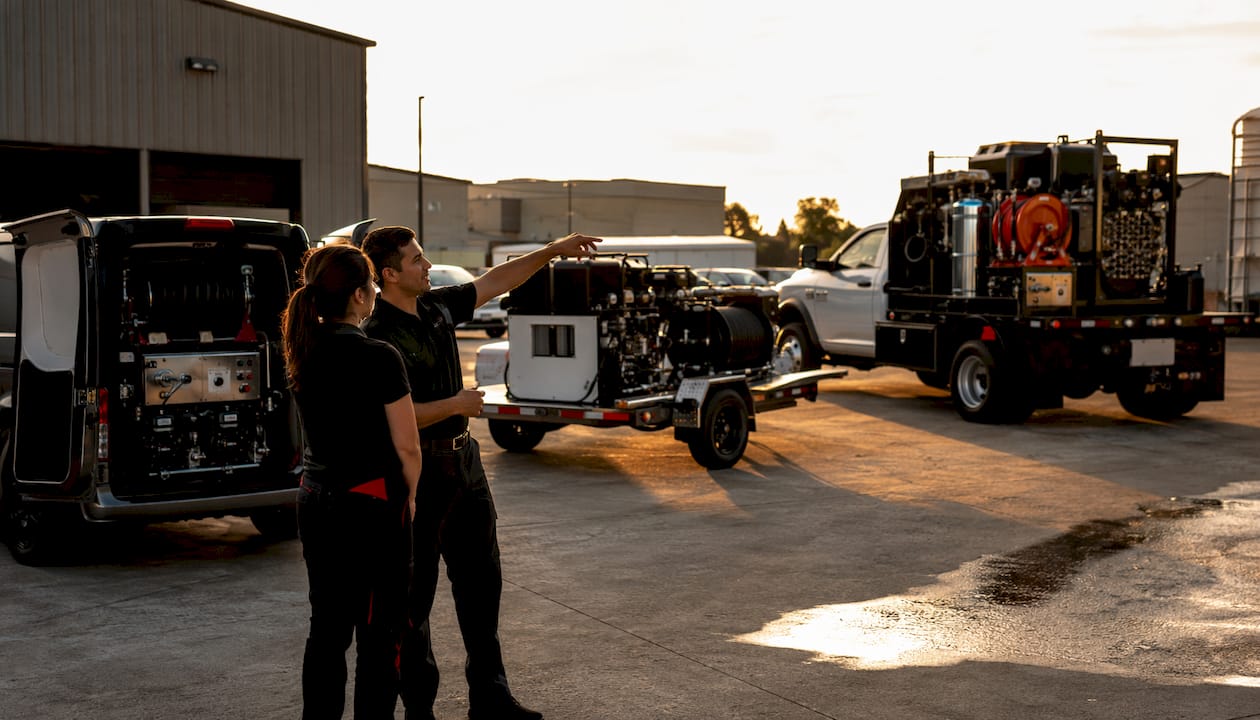
A pressure washing skid is a self-contained industrial cleaning platform designed to mount in a truck bed or on a trailer. It integrates the engine or motor, pump, water tanks, hose reels, and chemical storage on a single welded base frame, so the entire system loads and unloads as one unit.
The practical difference from a portable pressure washer is significant. A portable unit might handle one or two residential jobs before you’re refilling, repositioning, and managing loose hoses. A skid runs from its own onboard water supply, keeps chemicals staged and ready, and lets one or two operators work continuously on large commercial accounts — storefronts, apartment complexes, fleet vehicles, or industrial facilities. Setup time drops from 20–30 minutes of staging to pulling up, hitting start and making money.
For a contractor running a soft-wash house-wash program, the skid advantage is even sharper. You need a pressure pump, a 12V soft-wash pump, separate tanks for water and bleach, and a surfactant reservoir — all plumbed and wired. On a skid, that’s one load-in. Without one, it’s a staging exercise every single morning.
What mounting type fits your operation?
The three formats are truck-bed skids, trailer-mounted systems, and van or box-truck conversions. Each suits a different operational model.
Truck-bed skids
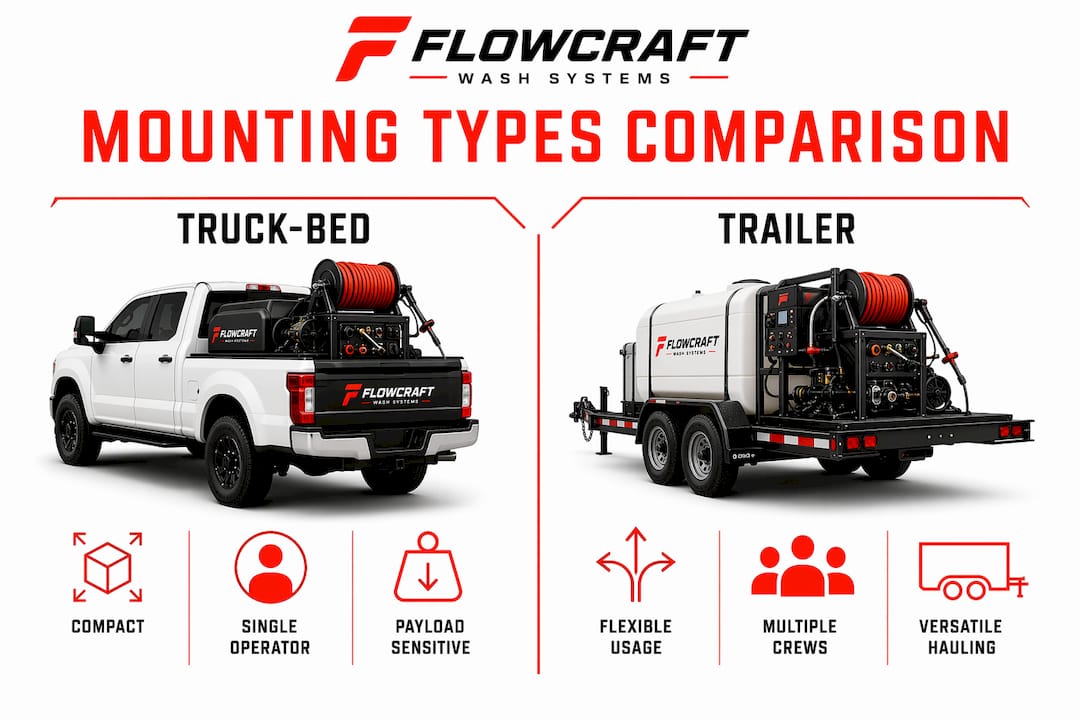
A truck-bed skid sits in the bed of a pickup and is secured with tie-downs or bolted mounting points. It’s the most common format for solo operators and small crews because it keeps the rig compact and maneuverable in tight residential neighborhoods. The tradeoff: your truck is dedicated to cleaning work while the skid is loaded. Swapping the truck for another job means pulling the skid. However, FlowCraft skids are fully reinforced to make loading and unloading a breeze if the need arises to swap vehicles.
Pros:
-
Low profile, easy to park in residential areas
-
No trailer registration or licensing required
-
Faster to deploy on single-stop jobs
Cons:
-
Truck payload limits tank capacity (verify your truck’s GVWR before specifying tank size)
-
Vehicle is committed to the rig while loaded
-
Limited expansion room compared to a trailer
Trailer-mounted skids
Trailer-mounted units are the preferred format when you need to preserve truck utility. You unhook the trailer at the job site, use the truck for supply runs or other tasks, and return to pick up. Trailers also allow larger tank capacities — commercial trailers commonly run 230–460 gallons — which matters for remote sites without a water hookup.
Pros:
-
Truck stays available for other uses
-
Higher tank and equipment capacity
-
Easier to expand the platform over time
Cons:
-
Requires trailer registration and, in some states, a specific license class
-
Harder to maneuver in tight residential driveways
-
Larger storage footprint at your shop
Van and box-truck conversions
Van conversions suit operators who want a fully enclosed, weather-protected rig. The equipment mounts inside the cargo area with through-wall plumbing. These rigs cost more to build and maintain, but they protect equipment in harsh climates and present a polished appearance on commercial accounts.
Decision rule: If you run multiple crews or need the truck for other tasks between jobs, go trailer. If you’re a single operator doing residential routes, a truck-bed skid setup is leaner and faster. Van conversions make sense once you’re running dedicated crews on commercial contracts and want to protect the investment.
Pro Tip: Before finalizing tank size on a truck-bed skid, check your truck’s payload rating against the combined weight of the skid frame, full water tanks, engine, and pump. A 150-gallon water tank alone adds over 1,250 lbs .
Which components and specs actually drive performance?
Every pressure washer skid setup shares the same core components, but the spec choices within each one determine whether the rig earns its keep on commercial accounts or becomes a maintenance headache.
Core components:
-
Pump: The heart of the system. Triplex plunger pumps handle continuous commercial duty far better than axial pumps, which are designed for intermittent residential use. For heavy-duty work, a triplex pump running at 1,750 RPM slow speed extends seal life significantly.
-
Engine/power source: Gas engines (Honda GO series, Kohler Command, Briggs & Stratton Vanguard) dominate commercial skids for their portability and power density. 12V electric pumps are standard for soft-wash chemical delivery — they run independently of the main engine and allow precise low-pressure application.
-
Burner (hot-water units): Diesel or kerosene burners add degreasing capability for fleet washing and industrial cleaning. A 3,500 PSI / 4 GPM hot-water configuration is a common mid-size spec for heavy-duty cleaning in a pickup-bed footprint.
-
Tanks: Separate tanks for fresh water, bleach, and surfactant are standard on professional soft-wash skids. Integrated tank layouts maximize usable truck-bed space for poles, surface cleaners, and ramps.
-
Hose reels: Most professional skids run two or more reels — one for high-pressure hose, one for the soft-wash line. Spring-retract reels reduce fatigue on high-volume days. Remote reels are also increasingly popular to remote retract your longer hoses.
-
Chemical injector: Downstream injectors (after the pump) are safer for the pump and easier to swap, but they dilute chemical concentration. Upstream injectors (before the pump) deliver higher chemical ratios but require chemical-compatible pump seals.
-
Frame and mounting: Aluminum framing is the professional standard — it’s lighter than steel and resists corrosion from chemical exposure. Reinforced welded wing mounts where heavy reels attach prevent fatigue cracking under road vibration.
-
Winterization: A built-in drain and quick-connect antifreeze flush port is cheaper to integrate during the build than to retrofit. In freezing climates, skipping this spec leads to cracked pump heads and burst plumbing.
Spec-to-job reference:
| GPM | PSI | Typical application | Production scale |
|---|---|---|---|
| 2.5 | 1,250 | Soft-wash roofs, house wash | Light to medium residential |
| 4.0–5.5 | 2,500–3,500 | Concrete, driveways, commercial storefronts | Medium to heavy commercial |
| — | 2,500–3,000 | Fleet washing, industrial equipment | High-volume industrial |
Pro Tip: For nozzle selection, size the orifice to your pump’s rated GPM at operating pressure — an undersized nozzle starves the pump and builds back-pressure. Flowcraftwash’s Billet Nozzle Block is CNC-machined from aluminum and allows multiple nozzle configurations from a single manifold, which simplifies switching between soft-wash and pressure-wash modes without fumbling through different loose tips.
Should you buy turnkey or build your own skid?
For most commercial contractors, buying a turnkey skid is the right call. The math is straightforward: a DIY build requires sourcing a frame, pump, engine, tanks, reels, plumbing fittings, wiring, and mounting hardware separately, then fabricating and commissioning the system yourself. That’s weeks of lead time, no warranty on the assembled system, and zero commissioning support if something doesn’t perform on the first job.
Cost bands (ballpark ranges, not quotes):
-
Blank equipment skid only: Starting under $1,000 for the frame platform, depending on size and material. This is the starting point for experienced owners who want to source and mount their own components.
-
Mid-tier turnkey cold-water skid: $3,000–$7,000 assembled, depending on pump GPM/PSI, engine size, and tank configuration.
-
Hot-water commercial turnkey skid: $8,000–$20,000+, depending on burner capacity, pump spec, and trailer vs truck-bed format.
Timeline comparison: A DIY build sourcing parts individually typically runs 4–10 weeks from order to operational, assuming no fabrication delays or parts backorders. A factory-assembled turnkey unit from a manufacturer with dealer support typically ships in 2–6 weeks depending on configuration and customization level.
DIY builds make sense when you have an experienced in-house operator, you’re running a small single-operator setup with modest production demands, or you want a highly specific configuration no vendor stocks. For anyone scaling to multiple crews or commercial contracts, the warranty gap alone justifies buying turnkey. A pump failure on a DIY build with no service documentation costs you a day of revenue and a diagnostic headache. A turnkey build with a documented bill of materials and manufacturer support gets you back running faster.
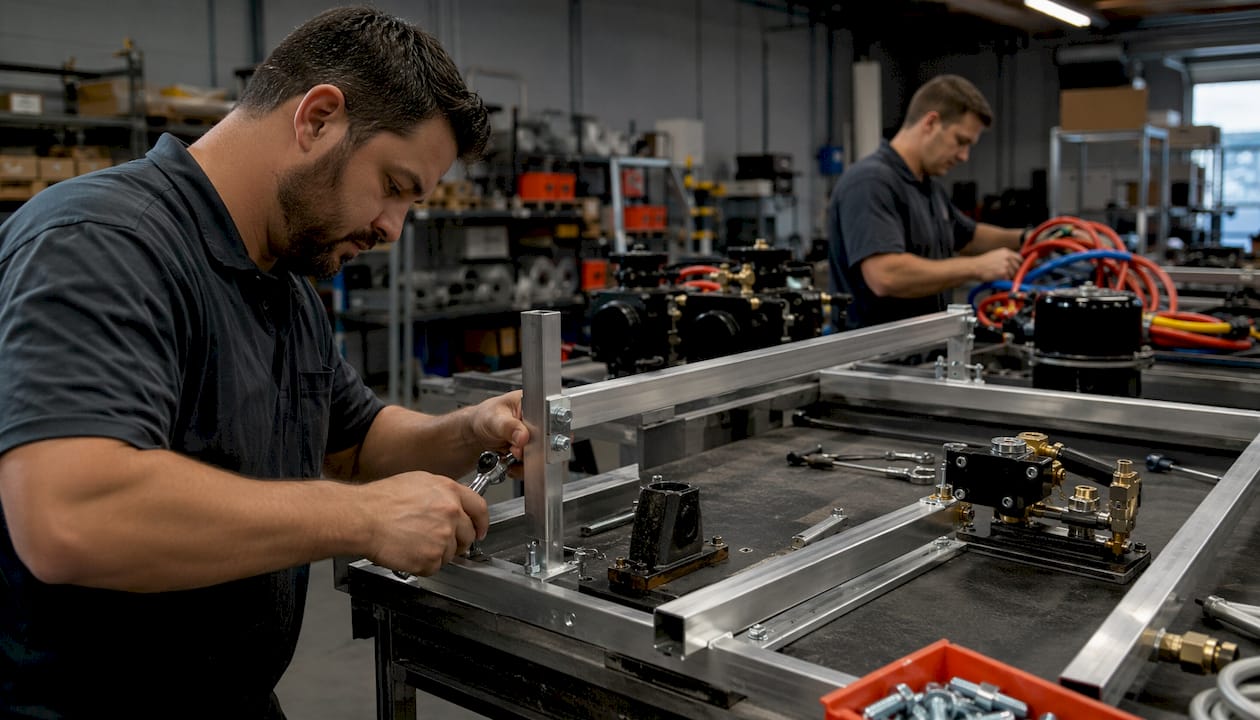
Turnkey integration of water supply, soft-wash systems, and hose management can save 15 minutes per job — across a five-day week with multiple stops, that’s a real production gain.
How to specify a skid: the buyer’s checklist
Hand this list to any vendor or fabricator before you commit.
-
Pump GPM and PSI: State your target job profile (soft-wash, concrete, fleet) and confirm the pump is rated for continuous commercial duty at those specs.
-
Power source: Gas engine (specify brand and displacement), 12V electric, or dual-power configuration.
-
Tank capacity: Fresh water, bleach, and surfactant volumes in gallons — confirm the combined weight fits your vehicle’s payload rating.
-
Hose reel count and capacity: Number of reels, hose diameter, and footage per reel.
-
Plumbing thread standards: Confirm all fittings are standard NPT or JIC — non-standard threads create field repair nightmares. FlowCraft also utilizes SAE straight thread fittings in stainless steel for dependable long term use.
-
Mount points: Specify tie-down locations, bolt patterns, or trailer hitch class.
-
Winterization: A drain valve and antifreeze flush port on any hot-water unit or any skid operating in a climate with freezing temperatures. A drain is standard equipment on all FlowCraft turn key skids, with availability for the customer to call out size and connection type.
-
Warranty terms: Get the warranty in writing — what’s covered, for how long, and who handles service.
Three questions for your supplier call:
-
“What’s your current lead time for this configuration?”
-
“What does the warranty cover, and do you offer a service plan?”
-
“Does the price include commissioning or operator training?”
Red flags to reject on sight:
-
Hot-water unit with no winterization provision
-
No welding certifications or proof of reliability
-
Undersized equipment provisions
-
No service documentation or parts list included with the unit
-
Vendor who can’t name the specifics of their units and how parts are sourced.
Maintenance, vibration, and safe transport
Vibration is the primary cause of premature failure on mounted systems. A skid bolted directly to a truck bed without isolation hardware transmits every road bump directly to pump seals, hose fittings, and reel mounts. Heavy-duty anti-vibration pads between the skid frame and the truck bed cost very little and extend service life measurably. Reinforce welded wing mounts where reels attach — those are the first points to fatigue under sustained road vibration.
Maintenance by cadence:
Monthly:
-
Check pump oil level and condition; change if discolored
-
Inspect all hose connections for weeping or cracking
-
Test unloader valve function
-
Check belt tension on belt-drive units
Quarterly:
-
Full pump oil change
-
Inspect chemical injector for wear or clogging
-
Check anti-vibration pads for compression set or cracking
-
Test winterization drain and flush ports
Annually:
-
Full burner service on hot-water units (nozzle, fuel filter, igniter)
-
Inspect frame welds at all mounting points for fatigue cracks
-
Replace hoses showing UV degradation or kinking
-
Verify all electrical connections and 12V pump wiring
Safe transport: Secure hose reels with locking pins or straps before moving — a free-spinning reel on the highway unwinds hose and creates a serious hazard. Fuel tanks should be no more than three-quarters full during transport to reduce spill risk. Design service access into the skid from the start: quick-disconnect fittings and hinged service panels mean you can swap a pump in the field without pulling the entire skid.
FlowCraft recommended configurations
FlowCraft Wash builds custom skids for contractors across residential soft-wash, commercial pressure washing, and industrial cleaning. Three configurations cover the majority of commercial use cases.
Configuration 1: Soft-wash truck-bed skid
Best for: Residential and light commercial soft-wash contractors running house washes, roof treatments, and fence cleaning.
Core BOM: FlowCraft Blank Equipment Skid , 12V soft-wash pump, fresh water tank, chemical tank, surfactant tank, FlowCraft Billet Nozzle Block, downstream chemical injector, single hose reel (soft-wash line), and wiring harness.
Configuration 2: Dual-purpose pressure and soft-wash skid
Best for: Contractors who need both soft-wash delivery and pressure washing from one platform — the most common commercial configuration.
Core BOM: Aluminum equipment skid, gas-powered triplex plunger pump (4.0–5.5 GPM / 2,500–3,500 PSI), 12V soft-wash pump, fresh water tank, chemical tank, surfactant tank, two hose reels (high-pressure and soft-wash), FC Billet Nozzle Block, downstream injector, unloader valve, and engine-start wiring.
Configuration 3: Hot-water commercial skid
Best for: Fleet washing, industrial degreasing, and commercial accounts where cold water alone won’t cut through grease, oil, or heavy organic buildup.
Core BOM: Heavy-duty aluminum skid frame, gas engine (22+ HP), triplex plunger pump (4.0 GPM / 3,500 PSI or higher), diesel burner assembly, fresh water tank, two hose reels, FC Billet Nozzle Block, thermal relief valve, winterization drain and flush port, and full service documentation.
Configuration comparison:
| Configuration | Best for | Pump GPM / PSI | Power source | Tank capacity | Mounting | Price band |
|---|---|---|---|---|---|---|
| Soft-wash truck-bed | Residential soft-wash | 12V / low pressure | 12V electric | 230–460 gallons | Truck bed | Starting at $5,000 |
| Dual-purpose pressure + soft-wash | Commercial house wash / storefronts | 4.0–5.5 GPM / 2,500–3,500 PSI | Gas + 12V | — | Truck bed or trailer | Starting at $8,000 |
| Hot-water commercial | Fleet / industrial degreasing | 4.0 GPM / 3,500 PSI+ | Gas + diesel burner | — | Truck bed or trailer | Starting at $12,000 |
All FlowCraft Wash warranty terms are confirmed at the time of order. Contact FlowCraft directly for a custom quote — configurations are tailored to your vehicle, job profile, and production targets.
Key Takeaways
A turnkey pressure washing skid from FlowCraft gives commercial contractors the fastest path from purchase to production.
| Point | Details |
|---|---|
| Choose your mounting type first | Truck-bed skids suit solo residential operators; trailers preserve truck utility for multi-crew or remote-site work. |
| Match pump GPM/PSI to your job profile | Soft-wash runs 12V low-pressure; commercial concrete and storefronts need 4.0–5.5 GPM at 2,500–3,500 PSI; industrial degreasing scales higher. |
| Require winterization and anti-vibration mounting | Skipping either spec leads to pump damage and premature frame fatigue — integrate both during the build, not after. |
| Prefer turnkey with training when scaling | A documented BOM and included commissioning reduce downtime and warranty gaps that DIY builds can’t match. |
| Verify local water-disposal rules before operating | Many US jurisdictions require wastewater capture or permitted discharge under NPDES rules — check municipal codes before your first commercial job. |
| FlowCraft Wash as the recommended option | FlowCraft’s three configurations cover soft-wash, dual-purpose, and hot-water commercial needs with custom aluminum skids. |
What contractors actually get wrong when buying a skid
Most buyers focus on PSI. That’s the wrong number to anchor on. PSI tells you how hard the water hits; GPM tells you how fast you clean. A 4,000 PSI / 2 GPM unit will take twice as long to rinse a concrete pad as a 3,000 PSI / 4 GPM unit. For production work, GPM is the number that drives revenue per hour.
The second mistake is underspecifying the chemical system. Contractors who buy a pressure-only skid and then try to add soft-wash capability later end up with a cobbled-together rig that’s harder to maintain and slower to operate. Building the chemical delivery system into the skid from day one — separate tanks, dedicated 12V pump, Billet Nozzle Block for switching modes — is the difference between a professional rig and a field modification that causes problems six months in.
The third mistake is ignoring vibration isolation until something breaks. By then, you’ve already shortened the life of your pump seals and stressed your frame welds. Anti-vibration pads and reinforced wing mounts are a small line item on the BOM. They’re not optional on a commercial rig that logs highway miles every day.
FlowCraft Wash builds skids that are ready to work on day one
Skip the parts-sourcing marathon. FlowCraft delivers custom pressure-washing skids with everything spec’d, assembled, and documented — aluminum equipment skid, integrated chemical tanks, hose reels, and your choice of cold or hot-water pump configuration. Every build includes commissioning guidance so your crew isn’t figuring out the rig on a paying job.
The difference from buying components piecemeal: you get a single warranty, a complete parts list, and a system that was designed to work together from the frame up. Whether you need a soft-wash truck-bed setup for residential routes or a hot-water commercial skid for fleet accounts, FlowCraft configures it to your vehicle and job profile.
Ready to spec your build? Request a custom quote or browse the Blank Equipment Skid as your starting platform.
Useful sources and further reading
-
SCE TMS 4035-K-G-PSR Hot-Water Pickup Skid — Technical specs for a 3,500 PSI / 4 GPM hot-water pickup skid; useful for benchmarking mid-tier commercial configurations and winterization features.
-
Landa Commercial Pressure Washer Trailers — Manufacturer reference for trailer platform specs, tank capacities (230–460 gallons), and dealer support models; use for trailer lead-time and warranty benchmarks.
-
MITM Industrial Trailers — Municipal Considerations — Background on local municipal codes and Clean Water Act NPDES requirements for commercial pressure-washing wastewater; start here before operating commercially.
-
Simpson Cleaning — Mobile Pressure Washer Trailers — Range of commercial trailer configurations from 3,200–4,200 PSI with triplex pump options; useful for comparing pump and engine pairings across production tiers.
-
FlowCraft Wash— Blank Equipment Skid — FlowCraft’s aluminum equipment skid product page; the recommended starting platform for contractors specifying a custom build.
-
FlowCraft Wash — Billet Nozzle Block — CNC-machined aluminum nozzle block for multi-mode chemical and pressure delivery; technical specs and ordering for this BOM component.